Every five years, the U.S. government releases updated Dietary Guidelines for Americans (DGAs), which are the nation’s official nutrition guidance for promoting health and preventing chronic disease. While many people never read the full report, its recommendations shape much of the nutrition advice we see in healthcare settings, public health programs, and the media.
The guidelines are developed through a two-step process. First, an independent group of scientists known as the Dietary Guidelines Advisory Committee (DGAC) reviews the latest nutrition research and produces a scientific report. The U.S. Department of Health and Human Services and the U.S. Department of Agriculture then use that report, along with other policy considerations, to publish the final guidelines.
These recommendations influence everything from school meals and senior nutrition programs to the advice clinicians give their patients. The newest edition, released in January 2026 and covering 2025–2030, is noticeably shorter and more consumer-friendly than past versions. It also introduces a new visual, the inverted food pyramid, that has generated a lot of discussion among nutrition experts and in the media.
Like most updates to nutrition guidance, the new guidelines have sparked debate across the nutrition community. Here are some of the topics experts are talking about:
The Advisory Committee’s Scientific Report versus the Final Guidelines
One of the biggest conversations around the 2025 guidelines involves the relationship between the advisory committee’s scientific report and the final policy document. Historically, the federal guidelines closely follow the committee’s recommendations. This time, some researchers say the final guidance diverges more than usual from the advisory report. For example, critics have pointed to the way the final document emphasizes certain foods, such as animal-based proteins and dairy, compared with earlier versions.
At the same time, others note that the Dietary Guidelines have always been a policy document informed by science, not simply a scientific report. Government agencies must translate complex research into advice that is practical, understandable, and relevant to national food programs.
For the public, the takeaway is simple: debates among scientists are a normal part of nutrition research. Over time, guidelines evolve as evidence grows and policies adapt.
The Return of the Food Pyramid, But Flipped Upside Down
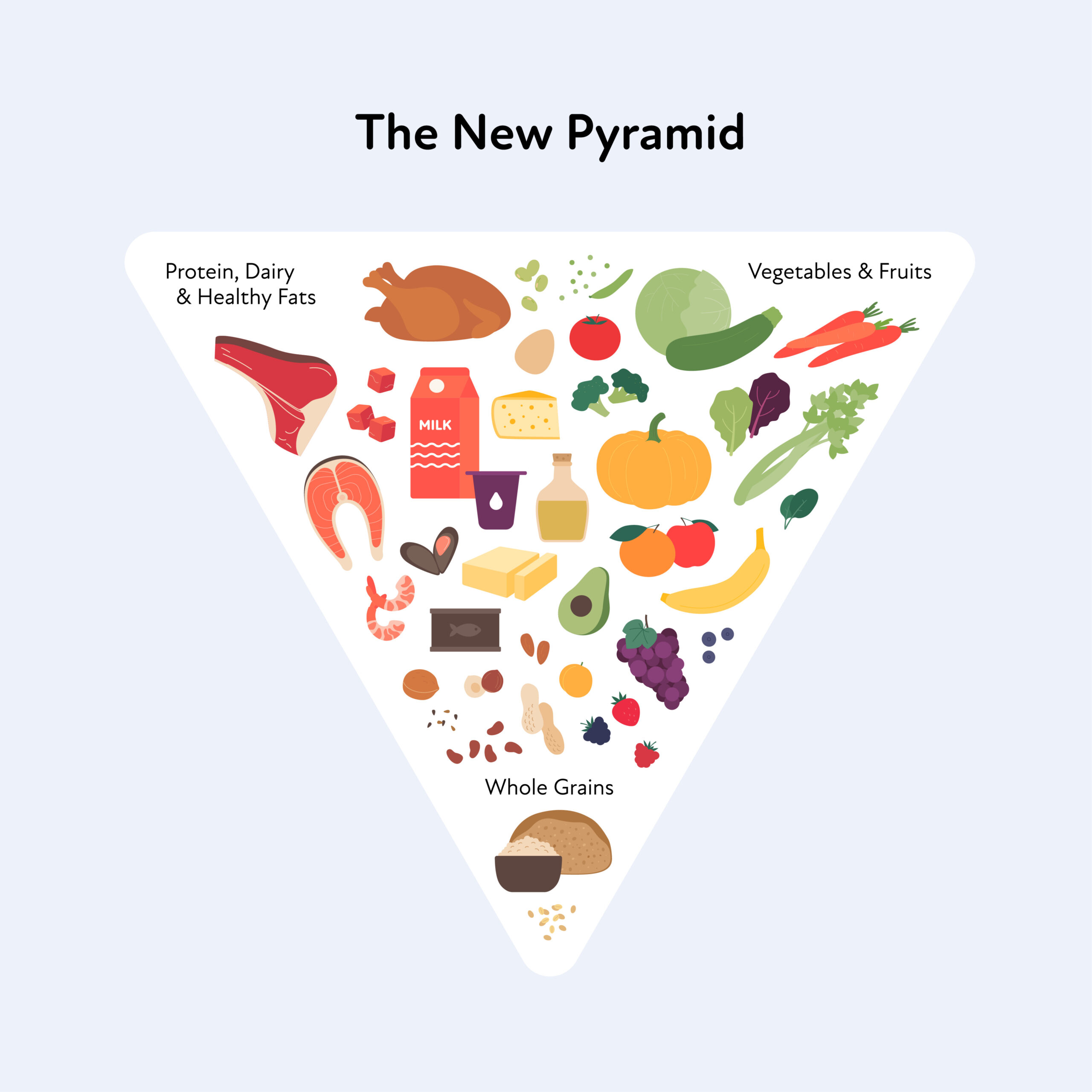
One of the most visible changes in the new guidelines is the return of a familiar graphic: the food pyramid. But this version is flipped upside down. Earlier pyramids, such as those from the 1990s, placed grains at the broad base of the pyramid, with fats and sweets at the top. The new inverted pyramid shifts the emphasis. The largest section now highlights protein foods, dairy, healthy fats, and fruits and vegetables, while whole grains appear in a smaller section near the bottom.
Supporters say the new design reflects a shift toward prioritizing nutrient-dense foods and balanced meals, rather than focusing heavily on refined carbohydrates. Critics argue that the visual could be confusing or inconsistent with the written recommendations, which still encourage regular consumption of whole grains.
Either way, the pyramid is meant to be a simple visual guide, not a detailed set of instructions. The written guidelines still emphasize variety and balance across food groups.
Ultra-Processed Foods Enter the Conversation
Another notable addition to the guidelines is the explicit discussion of ultra-processed foods (UPFs). These are foods that have undergone significant industrial processing and often contain ingredients not typically used in home cooking, such as flavor enhancers, emulsifiers, and other additives. Examples include many packaged snacks, sugary beverages, and ready-to-eat convenience foods. Researchers have increasingly linked diets high in UPFs to higher risks of obesity, diabetes, and heart disease.
The guidelines now encourage Americans to limit UPFs. However, there is still debate among scientists about how exactly to define “ultra-processed.” Some researchers use the NOVA classification system, which categorizes foods based on processing levels. Others argue that the system can be too broad and may label some foods as ultra-processed even if they can contribute to a healthy diet.
For everyday eating, though, the message is fairly straightforward: meals built mostly from whole or minimally processed foods tend to support better health.
The Challenge of Turning Guidance Into Daily Habits
Another theme raised by experts is that guidelines alone don’t automatically change behavior. Many people already understand the basics of healthy eating: more fruits and vegetables, less added sugar, and fewer heavily processed foods. The challenge is putting those principles into practice day after day. Time constraints, food costs, cultural traditions, and long-standing habits all play a role in what people eat.
That’s why many nutrition professionals emphasize that successful dietary guidance needs more than charts or diagrams. Successful guidance requires practical strategies that help people make healthier choices in real life.
What Hasn’t Changed
Despite the debate surrounding the new guidelines, many core recommendations remain consistent with previous versions. Across a wide range of scientific perspectives, there is still strong agreement on several key principles of healthy eating:
- Eat plenty of vegetables and fruits
- Choose whole grains more often than refined grains
- Include a variety of protein sources
- Limit added sugars and excess sodium
- Keep highly processed foods to a minimum
- Focus on overall eating patterns rather than individual “good” or “bad” foods
These fundamentals have remained remarkably stable over decades of nutrition research.
5 Practical Ways to Apply the New Guidelines
Nutrition debates can make healthy eating seem complicated. But most of the recommendations, both old and new, still point in the same direction. Here are a few practical ways to put them into action:
- Build meals around whole foods.
Try to center most meals on foods that look close to how they come from nature, such as vegetables, fruits, beans, whole grains, seafood, nuts, dairy, and minimally processed meats. Convenience foods can still have a place, but they shouldn’t make up the majority of your diet. - Include protein regularly throughout the day.
Protein plays an important role in maintaining muscle and strength as we age. Aim to include a source of protein at each meal, such as fish, poultry, eggs, beans, yogurt, tofu, nuts, or lean meats. - Pay attention to added sugars and sodium.
These two ingredients remain consistent targets in the guidelines. Small changes, such as choosing unsweetened beverages, cooking more meals at home, or comparing labels, can make a meaningful difference over time. - Don’t fear processing. Focus on balance.
While the new guidelines highlight ultra-processed foods, not all processed foods are unhealthy. Frozen vegetables, canned beans, whole-grain bread, and yogurt can all support a healthy diet. The goal is to limit foods that are heavily processed and high in added sugars, refined starches, or excess sodium. - Focus on patterns, not perfection.
Healthy eating is less about individual foods and more about the overall pattern over weeks and months. Occasional indulgences are part of life. The key is what your diet looks like most of the time.
The Bottom Line
Nutrition science continues to evolve, and the guidelines designed to translate that science into everyday advice evolve with it. The 2025–2030 Dietary Guidelines introduce new elements, including the inverted pyramid and greater attention to ultra-processed foods, while also sparking debate about how best to interpret the evidence.
For most people, however, the path to better health remains familiar. A diet centered on whole foods, balanced meals, and moderation, combined with habits that fit your lifestyle, continues to be one of the most reliable ways to support long-term health. And while guidelines may change over time, those basic principles remain surprisingly consistent.
References:
Center for Science in the Public Interest (CSPI). (2026). What changed in the new Dietary Guidelines and why it matters.
https://www.cspi.org/cspi-news/what-changed-new-dietary-guidelines-why-it-matters
U.S. Department of Health and Human Services & U.S. Department of Agriculture. (2026). Dietary Guidelines for Americans, 2025–2030.
https://www.dietaryguidelines.gov/
Dietary Guidelines Advisory Committee. (2025). Scientific Report of the 2025 Dietary Guidelines Advisory Committee.
https://www.dietaryguidelines.gov/2025-advisory-committee-report
Micha, R., Mozaffarian, D., & others. (2026). Federal dietary guidance upended. JAMA Health Forum.
https://jamanetwork.com/journals/jama-health-forum/fullarticle/2845870